Language models
Metalhead also ports language models from Hugging Face Transformers, starting with the Llama, Qwen, Gemma 3 and Granite architectures (LlamaForCausalLM, Qwen2ForCausalLM, Qwen3ForCausalLM, Qwen3MoeForCausalLM, Qwen3_5ForCausalLM, Qwen3_5MoeForCausalLM, Gemma3ForCausalLM, GraniteForCausalLM, GraniteMoeForCausalLM, GraniteMoeSharedForCausalLM and GraniteMoeHybridForCausalLM), and the Qwen3.5 models that also read images, Qwen3_5ForConditionalGeneration and Qwen3_5MoeForConditionalGeneration (see Vision-language models). They load from the Hub like the timm models:
using Metalhead

model = create_model("HuggingFaceTB/SmolLM2-135M")
Any Hub repository whose config.json names a ported architecture loads, with the same strict checks. See the list of models for the architectures and the checkpoints they were validated against.
Generating text
Metalhead ports no tokenizer: the tokenizer of a repository is a Tokenizer of HuggingFaceTokenizers.jl, which calls Hugging Face's tokenizers library through Python on the repository's tokenizer.json. Install it with Pkg.add("HuggingFaceTokenizers"). With it loaded, create_processor loads the processor of a model, a TextProcessor of its tokenizer, at the revision of its weights:
using HuggingFaceTokenizers

tok = create_processor("HuggingFaceTB/SmolLM2-135M")

prompt = "The capital of France is Paris, and the capital of Italy is"
new = generate(model, tok(prompt); max_new_tokens = 8)   # the token indices of 8 new tokens
println(prompt, decode(tok, new))
The capital of France is Paris, and the capital of Italy is Rome.
The capital of theToken indices start at 1, as for Flux's Embedding, and the index of a logit is that of its token: the processor gives token indices, and decode(tok, indices) takes them, as in decode(tok, argmax(logits[:, end])). The tokenizer itself, tok.tokenizer, gives and takes the token ids of Hugging Face, which start at 0.
The tokenizer is that of tokenizer.json, with the padding token (pad_token) of tokenizer_config.json. transformers reads the other settings of tokenizer_config.json too, such as add_bos_token, which create_processor doesn't.
generate is transformers' generate, which decodes greedily or samples with the settings of the checkpoint's generation_config.json, model.generation_config:
model.generation_config     # GenerationConfig(bos_token_id = 0, eos_token_id = (0,))
qwen = create_model("Qwen/Qwen3-0.6B")
qwen.generation_config      # GenerationConfig(do_sample = true, temperature = 0.6, top_k = 20,
                            #   top_p = 0.95, bos_token_id = 151643, ...)
SmolLM2 decodes greedily, until its end-of-text token or max_new_tokens. Qwen3 samples, from the 20 most likely tokens and of those the most likely of cumulative probability 0.95, after dividing the logits by a temperature of 0.6. Keyword arguments change the settings, with the names of transformers: do_sample = false decodes greedily, temperature, top_k, top_p, min_p, repetition_penalty, min_new_tokens, eos_token_id, ... and rng is the random number generator of sampling. generate returns the new tokens only, and for a batch, a matrix whose sequences are padded after their end-of-text token (see below).
Without generate, a loop runs the model and picks the next token, here greedily:
ids = tok(prompt).input_ids
for _ in 1:8
    ids = [ids; argmax(model(ids)[:, end])]       # not push!: on Julia 1.10, it errors here
end
Each step of this loop runs the model on the whole sequence so far. A key-value cache, which generate uses, runs it on the new token only.
The logits of the last position give the probabilities of the next token:
using Flux: softmax

p = softmax(model(tok("The capital of France is"))[:, end])
top = sortperm(p; rev = true)[1:10]
[(decode(tok, i), p[i]) for i in top]   # (" the", 0.262), (" Paris", 0.094), ...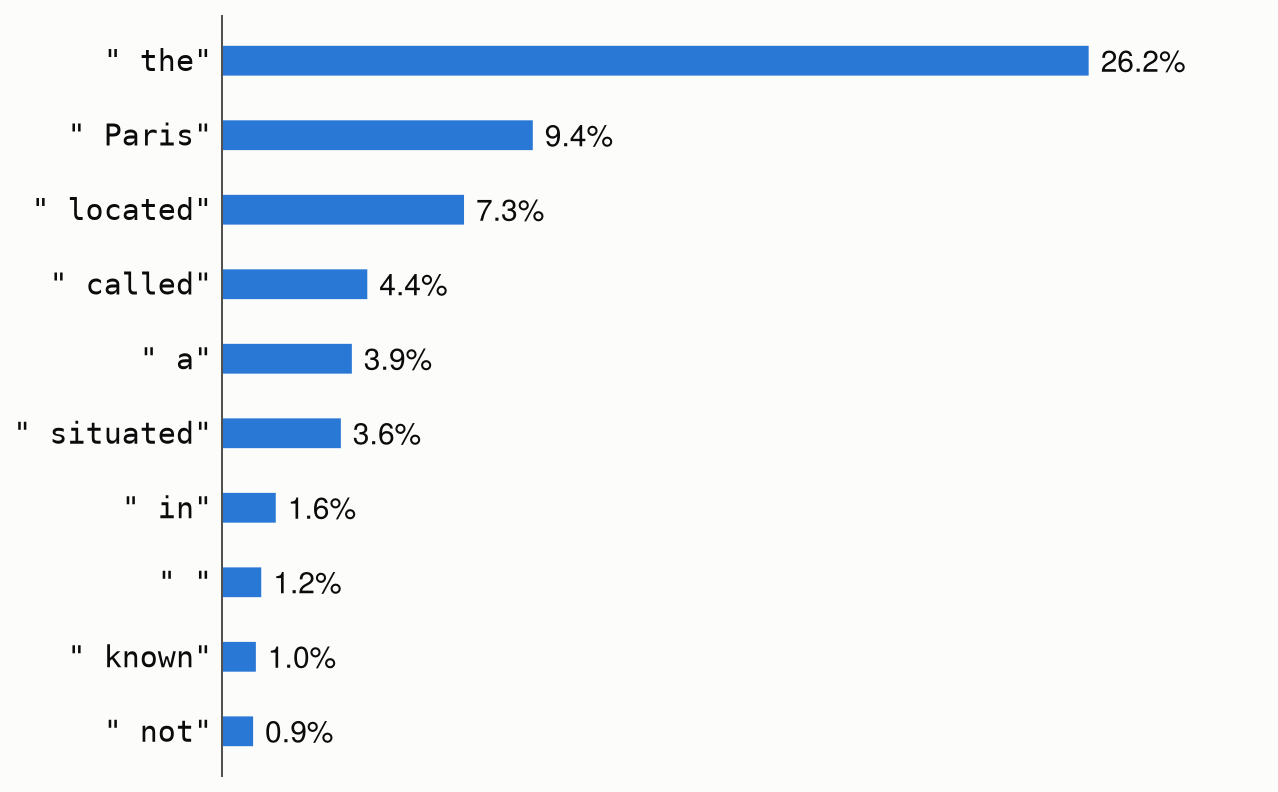
The ten most probable tokens to follow "The capital of France is", for SmolLM2-135M. Greedy decoding takes the first; sampling takes each with its probability.
Batches
The processor pads texts of different lengths on the right into a batch, with an attention_mask that is 0 for the padding, and the model takes them as they are:
inputs = tok(["The capital of France is", "Hello"])
size(inputs.input_ids)          # (5, 2)
inputs.attention_mask           # [1 1; 1 0; 1 0; 1 0; 1 0]
logits = model(inputs)          # 49152 × 5 × 2
The padding takes no part in the attention of the other tokens, so its token doesn't matter, and the logits of each text are those it has alone, at the positions of its tokens, up to rounding. The processor pads with the padding token of the tokenizer, or, for a tokenizer without one, such as SmolLM2's, with the token index 1.
generate continues each text of a batch after its last token, and returns a matrix of the new tokens, n × batch_size. A sequence that ends, with an end-of-text token, before max_new_tokens is followed by padding tokens until the others end too:
new = generate(model, inputs; max_new_tokens = 8)
[decode(tok, c) for c in eachcol(new)]   # decode skips the end-of-text and padding tokens
transformers pads the prompts of generate on the left; with the same tokens, the outputs are the same, except with a repetition penalty, which transformers applies to the padding tokens too, and which generate applies to the tokens of each sequence only.
Key-value cache
A KVCache keeps the keys and values of the tokens the model has seen, so that each step of a generation loop computes the new token only. It is allocated for a batch size and a maximum length, and model(ids; cache) returns the logits and the cache, which it updates in place. generate uses it, and so can your own loop; the loop above becomes:
using Metalhead.Transformers: KVCache, last_tokens

ids = tok(prompt).input_ids
cache = KVCache(model, 1, 64)                     # one sequence of up to 64 tokens
logits, _ = model(ids; cache)                     # the prompt
for _ in 1:8
    ids = [ids; argmax(logits[:, end])]
    logits, _ = model(ids[end:end]; cache)        # the new token alone
end
Its logits are those of a forward pass over the whole sequence, up to rounding. Sequences of different lengths go in one batch, padded on the right as above. The first call, the prefill, takes the attention_mask and gives each sequence its length in cache.lengths; the next token of each is predicted at its last token, not at the last position, which is padding for the shorter ones (last_tokens picks them). Each later step adds the same number of tokens to every sequence, whatever its length:
inputs = tok(["The capital of France is", "Hello"])
cache = KVCache(model, 2, 64)
logits, _ = model(inputs; cache)                  # the prefill of both texts
next = argmax.(eachcol(last_tokens(logits, cache.lengths)))
logits, _ = model(reshape(next, 1, :); cache)     # one more token for each text
A step can add several tokens, such as the chunks of a long prompt. The cache is for inference, not for gradients, and empty!(cache) makes it ready for new sequences. Llama, Qwen2, Qwen3, Qwen3 MoE and Granite have one; Gemma 3 and Qwen3.5 raise a "not supported yet" error, and their generate runs the model on the whole sequence at each step. Beam search and the other decoding strategies of transformers are left to your loop (see the scope).
Inputs and outputs
model(ids)takes token indices of size(seq_len, batch_size), or a vector for a single sequence, and returns logits of size(vocab_size, seq_len, batch_size)(or(vocab_size, seq_len)).- Attention is causal. Sequences of different lengths are batched by padding them on the right and passing the
attention_mask, of size(seq_len, batch_size), as a keyword argument:model(ids; attention_mask). The padding takes no part in the attention of the other tokens.model(inputs)takes both from the output of the processor. forward_featuresreturns the hidden states after the final norm, of size(hidden_size, seq_len, batch_size), andforward_headapplies the output projectionlm_headto them.forward_intermediatesreturns the hidden states of the decoder layers, which diffusion models such as FLUX.2 use as text embeddings. It takes token indices, or the output of the processor, such as the batch above:forward_intermediates(model, inputs; indices = [9, 18, 27], intermediates_only = true). Thei-th is transformers'output_hidden_states[i], andfeature_infogives the size and the module of each layer.- The weights are converted to
eltype(Float32by default) when they are loaded, whatever their type on the Hub (oftenbfloat16). InFloat16andBFloat16the weights of the norms stayFloat32, and so does theA_logof the linear attention of Qwen3.5, as in its checkpoints.
Configuration
The keyword arguments of create_model are the fields of the model's config.json, with the names and defaults of transformers. With a repository, they override its configuration:
create_model("HuggingFaceTB/SmolLM2-135M"; pretrained = false, num_hidden_layers = 4)   # random weights
create_model("LlamaForCausalLM"; vocab_size = 1000, hidden_size = 64, intermediate_size = 128,
    num_hidden_layers = 2, num_attention_heads = 4, num_key_value_heads = 2)
The vision-language models (Qwen3.5) and the other models made of several parts have their fields in sub-configs, text_config and vision_config. A keyword of that name is merged into the sub-config of the repository, so that the other fields keep the checkpoint's values; a field that depends on the one you change, such as layer_types with num_hidden_layers, is changed too, or reset to its default with nothing:
create_model("Qwen/Qwen3.5-0.8B"; pretrained = false,
    text_config = (; num_hidden_layers = 4, layer_types = nothing))
The rotary embeddings are the default ones, or those scaled as in Llama 3.1 and later (rope_type = "llama3") or linearly ("linear"). Options that the ports don't implement raise an error. These are the other rotary embeddings, such as "yarn", and the sliding-window attention of Qwen2 and Qwen3 (use_sliding_window, for the layers past max_window_layers), which their released checkpoints leave off. Gemma 3 does have sliding-window attention: its layers attend either to all the previous tokens or to the last sliding_window of them, as its layer_types say. Granite 4.0 (GraniteMoeHybridForCausalLM) loads only without its Mamba layers, as granite-4.0-350m and granite-4.0-1b are; the -h- models have them.
transformers derives the Qwen2 and Qwen3 classes from Llama's, and their ports reuse the Llama structs: a Qwen2 or Qwen3 model is a LlamaForCausalLM, whose Qwen3 attention layers are Qwen3Attentions, and so is a Qwen3 MoE model. Qwen3.5 has its own Qwen3_5ForCausalLM, whose layers have either a gated delta rule (Qwen3_5GatedDeltaNet) or attention, and which Qwen3.5 MoE reuses. A Gemma 3 model is a Gemma3ForCausalLM whose decoder is a LlamaModel of Gemma3DecoderLayers, and the four Granite classes are GraniteForCausalLMs.
Mixtures of experts
In Granite MoE (GraniteMoeForCausalLM, and GraniteMoeSharedForCausalLM with a shared expert), the MLP of each layer is a sparse mixture of experts: a router picks the num_experts_per_tok experts of each token, whose outputs are summed with the router's weights. Each projection of the experts is one NNlib.grouped_mul over the tokens grouped by expert, so the experts compute only for their own tokens, as in transformers. Grouping the tokens by expert copies the experts of each token to the CPU, once per layer on a GPU. The load-balancing loss of training is not implemented.
Qwen3 MoE (Qwen3MoeForCausalLM, Qwen3-30B-A3B) and Qwen3.5 MoE (Qwen3_5MoeForCausalLM and Qwen3_5MoeForConditionalGeneration, Qwen3.6-35B-A3B) weight the experts of a token by the softmax of the router's logits over all the experts, renormalised over the chosen ones (in Qwen3 MoE only with norm_topk_prob). In Qwen3.5 MoE, every token also goes through a shared expert, weighted by a sigmoid gate. The checkpoints of Qwen3 MoE store one MLP per expert, which loads into the stacked weights of the experts; those of Qwen3.5 MoE store the stacked weights. Checkpoints that transformers 5 saves with save_pretrained have one MLP per expert in both: those of Qwen3.5 MoE don't load.